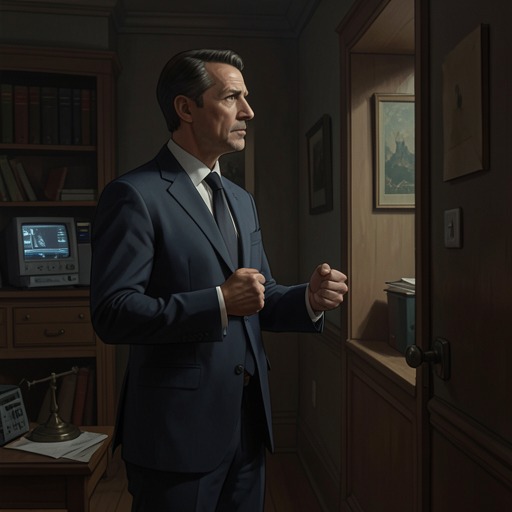
Robert Mallory’s fatal fall at Century Towers
The ShardsRobert Mallory’s fatal fall at Century Towers is the outcome of a confrontation between Robert and Bret Ellis that turns Bret’s search for Debbie Schaffer into a deadly struggle. The encounter unfolds across the high-rise apartment and its balconies; Robert falls to the garage roof, while Bret survives and tells responders that Robert jumped.
Causes and Background
Bret enters Abigail Mallory’s condo using a key he found in the room Robert occupied in the abandoned house on Benedict Canyon. He disables the entrance door and disconnects the apartment’s phones before going toward Robert’s bedroom. These actions leave the two men facing one another in a space where escape and communication have been restricted.
Robert appears with a knife, as does Bret. Bret says he wants Robert to confess and asks where Debbie is. Robert instead orders him to leave and accuses him of being with the people he fears. The scene’s central conflict is therefore also a conflict over what Bret believes Robert has done and what Robert believes Bret represents. Neither man persuades the other before the confrontation escalates.
The Fight and the Fall
The confrontation becomes physical when Robert lunges and slashes Bret across the face. Bret, disoriented and bleeding, loses sight of Robert briefly; Robert then attacks him again, stabbing toward his chest. Bret pushes him away and cuts him in return, and the struggle moves to the balcony. Robert tries to hold the sliding glass door shut from the other side while calling for help, but Bret kicks until the glass breaks. The shattered doorway opens the fight onto the high-rise’s exposed balconies, where each man is injured and neither can secure an escape.
Robert climbs over the railing and drops to the balcony below, the twenty-seventh floor. Bret follows, continuing to demand that Robert tell him where Debbie is. Robert attempts to descend again, toward the twenty-sixth-floor balcony, while the two grapple at the railing. Bret calls for him to stop and says he wants to help, but the encounter remains a struggle for control: Robert tries to get over the edge, and Bret tries to prevent him. As Robert hangs from the railing, Bret brings his fist down on the back of his hand. Robert falls silently into the darkness.
Immediate Aftermath and Conflicting Accounts
After Robert falls, the scene shifts from an active struggle to its uncertain public aftermath. Bret remains on the balcony, collapses, and calls for help as responders reach the apartment. Paramedics carry him away on a stretcher; another stretcher bears Robert’s remains. The contrast between the ordinary emergency response and the body’s altered, barely recognizable form makes the fall’s consequence both factual and difficult for Bret to comprehend.
Bret tells those around him that Robert attacked him and then jumped, insisting that he had tried to save his friend. While being taken through the building, he also accuses Robert of killing the girls and Debbie and attacking Susan. These are Bret’s frantic claims in the immediate aftermath, not an independent account establishing every allegation. The event therefore ends with a death confirmed but with the confrontation’s meaning filtered through a wounded, distraught survivor whose explanation is itself part of the scene.
Significance and Uncertainty
The fall closes a confrontation begun as Bret Ellis’s attempt to make Robert Mallory answer for Debbie Schaffer’s disappearance, but it does not settle the questions driving it. Bret arrives armed with a knife and says he wants a confession; Robert, also holding a knife, sees him as part of the group he fears. Their opposed understandings of the encounter leave no shared account of what is happening even as the struggle becomes unmistakably real. In the aftermath, Bret’s repeated insistence that Robert jumped and that he tried to save him coexists with his accusations against Robert, all delivered while he is injured and hysterical. The scene confirms Robert’s death, but presents its surrounding claims through Bret’s distressed account rather than an independent reconstruction. The abrupt silence before Robert’s fall, followed by the sound of impact and the responders’ arrival, marks the transition from a desperate contest to an irreversible public fact; the body’s unrecognizable condition then makes that fact difficult for Bret to absorb.